

Latest Past Events

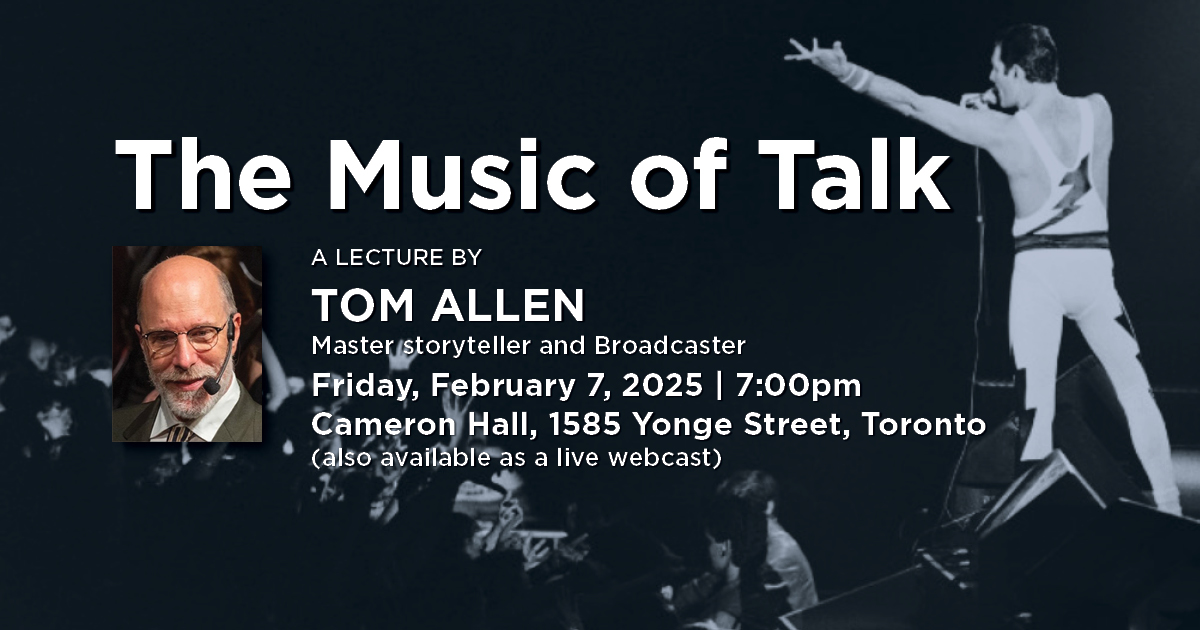
The Music of Talk

Cameron Hall 1585 Yonge Street, Toronto

With musical examples and the insight gained in a 40-year career combining the narrative and emotional connections between music and talk, master storyteller and broadcaster Tom Allen brings you on a stirring and inspirational journey to the deepest roots of human communication where melody and meaning become one.

Tom Allen was born in Montreal and went to school there, at Marianapolis College and McGill, before finishing degrees at Boston University and Yale. He worked as a bass trombonist in New York City when there were still places you just didn’t go, then in Toronto and on tour with the Great Lakes Brass. He began working for the CBC on his 30th birthday, a very long time ago, and at the time of writing is still there. He has since written three books, been a Resident Artist with Soulpepper Theatre, delivered storytelling workshops at various University music programs and at the Banff Centre, been named an honourary Doctor of Letters by Thompson Rivers University, hosted countless concerts across the country and written a series of cabaret storytelling shows he calls Chamber Musicals, including From Weimar to Vaudeville, The Missing Pages, A Poe Cabaret, Being Lost and the latest: JS Bach’s Long Walk in the Snow. Tom Allen lives in Toronto with his beloved, the harpist Lori Gemmell, their son, and a very enthusiastic dog.
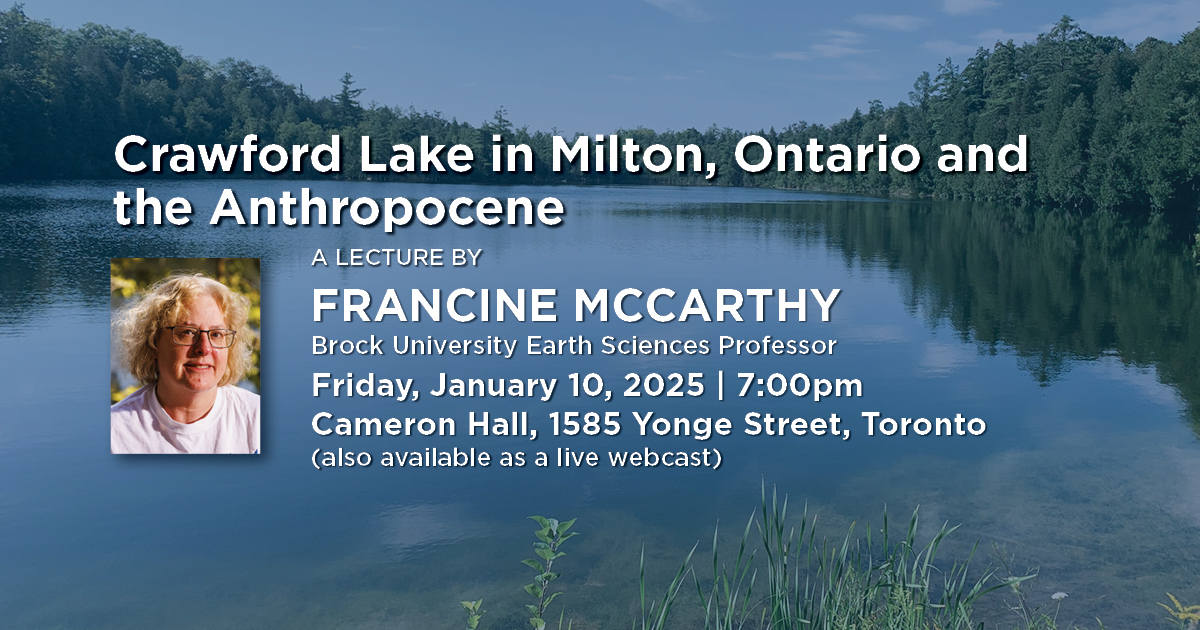
Crawford Lake in Milton, Ontario and the Anthropocene

Cameron Hall 1585 Yonge Street, Toronto

Lecture Description Although humans have impacted their environment for millennia, it is the fundamental change recorded by indicators of this Great Acceleration in the geologic record that justifies erecting a new interval of geologic time. Rejection of the proposal to define the beginning of the Anthropocene epoch with a ‘golden spike’ in varved sediments from Crawford Lake means that -by strict convention- we are still living in the Holocene– but is this societally relevant? Understanding how our planet functions allows us to make useful projections, and examining the geologic record allows us to predict the consequences of warmth equal or exceeding that of the last interglacial. Formally recognizing that ‘Holocene’ no longer accurately describes our planet by adding a new epoch named after the main agent of change (Anthropos, Greek for human) would highlight the value of Earth Sciences in addressing the existential issues that face humanity in the coming decades.

Biography Francine McCarthy is a geoscientist whose paleoecological and geoarchaeological research focuses on pollen and the remains of algae and their consumers in ‘pollen slides’. Her (and her students’) research includes recent studies of the intestinal contents of a mastodon found in Nova Scotia, an underwater archeological site in Greece, several sites in the Great Lakes and many small lakes in its drainage basin (including the Experimental Lakes Area of NW Ontario and Lake George, NY), the iconic Walden Pond and the meromictic Sluice Pond in Massachusetts. Her most highly publicised research has been on the varved sediments from Crawford Lake, proposed as the ‘golden spike’ to define the Anthropocene. She embraced the multi/ transdisciplinary nature of the proposed Anthropocene epoch and is a member of the Anthropocene Commons as well as the Anthropocene Working Group. In addition to NSERC funding to support research on ‘The impact of land use at mid-latitudes in eastern North America on the global carbon budget: implications for the Anthropocene’, she is co-recipient of a SSHRC grant entitled: ‘Bomb Pulse: Cultural and Philosophical Readings of Time Signatures in the Anthropocene’, through which she is currently writing a graphic novel. She has presented the results of her research on Crawford Lake in a Ted Talk and at the Vatican, among other venues.

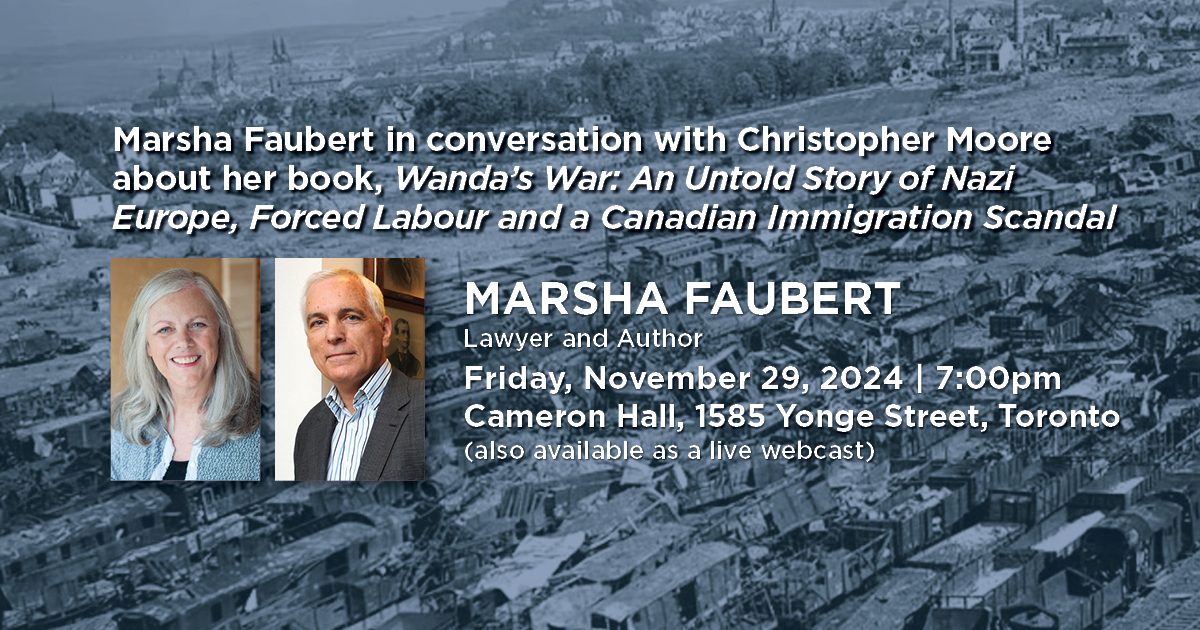
Marsha Faubert in conversation with Christopher Moore about her book, Wanda’s War: An Untold Story of Nazi Europe, Forced Labour and a Canadian Immigration Scandal

Cameron Hall 1585 Yonge Street, Toronto

Lecture Description : In Wanda’s War, Marsha Faubert introduces a dimension of the Second World War many Canadians have rarely contemplated. Stories of Canadians on the battlefield, the struggles of the home front, even the experience of Britons under bombing, are well known. But many of today’s Canadians trace their roots to the postwar migration of refugees from Eastern Europe and the Baltic states, whose war experiences remain buried.

Wanda’s War reconstructs the lives of Faubert’s parents-in-law, Wanda and Casey, and the lesser-known events of the war that shaped their lives. With not one, but two occupations of their homeland in Poland’s eastern borderlands, both were torn from their homes and deported to forced labour — one to Nazi Germany, the other to subarctic Russia. An “astonishing yet uplifting addition to the great body of literature of the Second World War” (David Marks Shribman), Wanda’s War speaks to the broader refugee experience that has unfolded globally since WWII and, tragically, continues today.

Historian Christopher Moore will join Faubert in a wide-ranging conversation about the book’s themes — the geopolitics of eastern Europe, gulags and slave labour camps, postwar displacement and immigration, and the politics of memory.

Biography : Marsha Faubert is a lawyer and writer of narrative nonfiction. She began her legal career as a litigator, and later worked in various roles in the administrative justice system in Ontario. Her first book,
Wanda’s War — An Untold Story of Nazi Europe, Forced Labour, and a Canadian Immigration Scandal, raises themes of memory and silence, justice and forgiveness through the lens of the wartime and immigration experiences of her husband’s parents. She is in the early stages of a new project which will examine the history and legacy of environmental injustice in her hometown of Sarnia, known to some as Canada’s Chemical Valley.