Latest Past Events

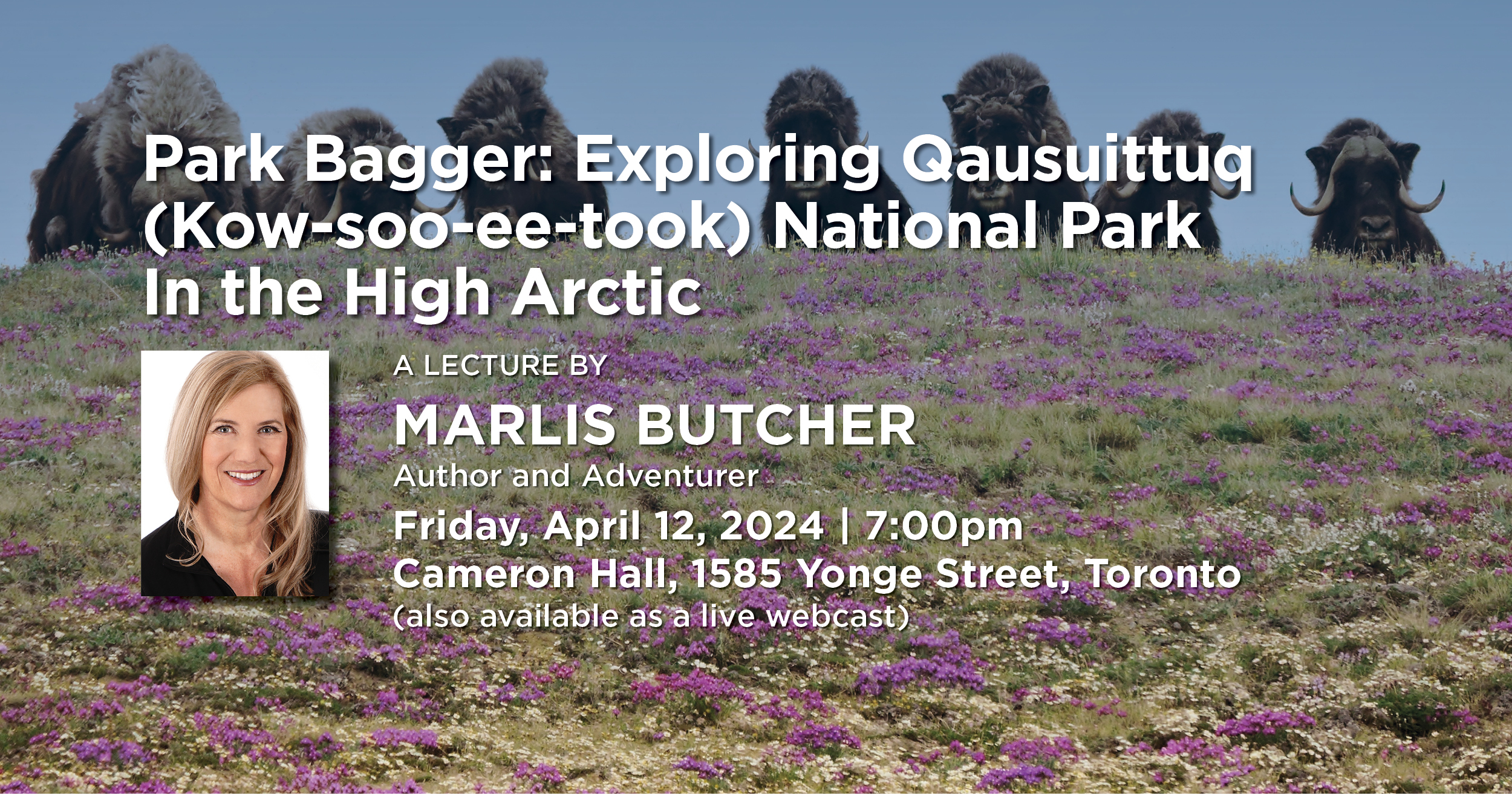
Park Bagger: Exploring Qausuittuq (Kow-soo-ee-took) National Park In the High Arctic

Cameron Hall 1585 Yonge Street, Toronto

Marlis Butcher was the first person to visit all 48 Canadian National Parks, one third of which have no road access, and in 2016 one of the first persons to visit Canada’s newest national park at the time, Qausuittuq, (pronounced Kow-soo-ee-took) in Nunavut. She is thus uniquely qualified to offer this lecture which will begin with an introduction to Canada’s National Parks system, then zoom in on the Arctic, and finally focus on exploring Qausuittuq National Park. Through unique photographs and engaging story-telling, Marlis will take us on a virtual voyage into the High Arctic, sharing what it’s like to travel to Canada’s true north, to explore this extremely remote park, and to meet its endangered inhabitants. 

This lecture is a live, in-person event in Cameron Hall. You do not need to pre-register to attend – just show up.

BIOGRAPHY:

Marlis Butcher is an environmental conservationist and a Fellow of the Royal Canadian Geographical Society and of The Explorers Club. Marlis is the first visitor to bag (visit) all 48 Canadian national parks, one third of which have no road access. To share the park experience and encourage appreciation of these natural wonders, she published her first book, Park Bagger – Adventures in the Canadian National Parks, a collection of short stories of adventure and discovery.

“Newfoundland: From Country to Province” (On the 75th anniversary of Newfoundland’s Confederation with Canada)

Cameron Hall 1585 Yonge Street, Toronto

Newfoundland was a country before it became a province of Canada in 1949. Why did it remain separate for so long and why did it change course in the 1940s? In this lecture, David MacKenzie will look at the impact of the Great Depression on Newfoundland and the emergence of the country after 1939 as the Gibraltar of the Atlantic. In 1934, pushed financially, Newfoundland lost self-government in favour of administration by a British appointed Commission, but during the Second World War the country prospered, and the British grip weakened. Both Canada and the United States built bases in Newfoundland and the country turned in a decidedly North American direction. The outcome was an intense postwar political round leading to union with Canada seventy-five years ago. 

This lecture is a live, in-person event in Cameron Hall. You do not need to pre-register to attend – just show up.

BIOGRAPHY:

Dr. David MacKenzie is a graduate of McGill University and the University of Toronto and a professor of history at Toronto Metropolitan University. His main areas of academic interest are in Canadian history and international relations and the study of international organizations. He is the author of several books, including Inside the Atlantic Triangle: Canada and the Entrance of Newfoundland into Confederation, 1939-1949 (1986) and ICAO: A History of the International Civil Aviation Organization (2010). His most recent book is King and Chaos: The 1935 Canadian General Election (2023).

This lecture is co-sponsored by the Newfoundland & Labrador Historical Society.

Modest Hopes: Homes and Stories of Toronto’s Workers from the 1820s to the 1920s

Cameron Hall 1585 Yonge Street, Toronto

In this lecture based on the book of the same title, Don Loucks will tell the stories of Toronto’s built heritage of row houses, semis, and cottages and the people who lived in them. Too often, workers’ cottages are characterized today as being small, poorly built, and disposable. But in the late 1800s, to have worked and saved enough money to move into one was an incredible achievement. Moving from the crowded conditions of boarding houses, or areas such as Toronto’s Ward, to a self-contained, six-hundred-square-foot cottage was the result of an unimaginably strong hope for the future and a commitment to what lay ahead. For the workers and their families, these houses were far from modest. The architectural details suggested status, value, and pride of place and reminded the workers of the homeland from which they had come. 

This lecture is a live, in-person event in Cameron Hall. You do not need to pre-register to attend – just show up.

BIOGRAPHY:

Don Loucks is an architect, urban designer, and cultural heritage planner, with forty years of project experience. He is committed to environmental, economic, and cultural sustainability, and to preserving the variety of rich urban forms that contain the stories of our communities’ history. He lives in Toronto. 

This Lecture is co-sponsored by the Toronto Society of Architects.