

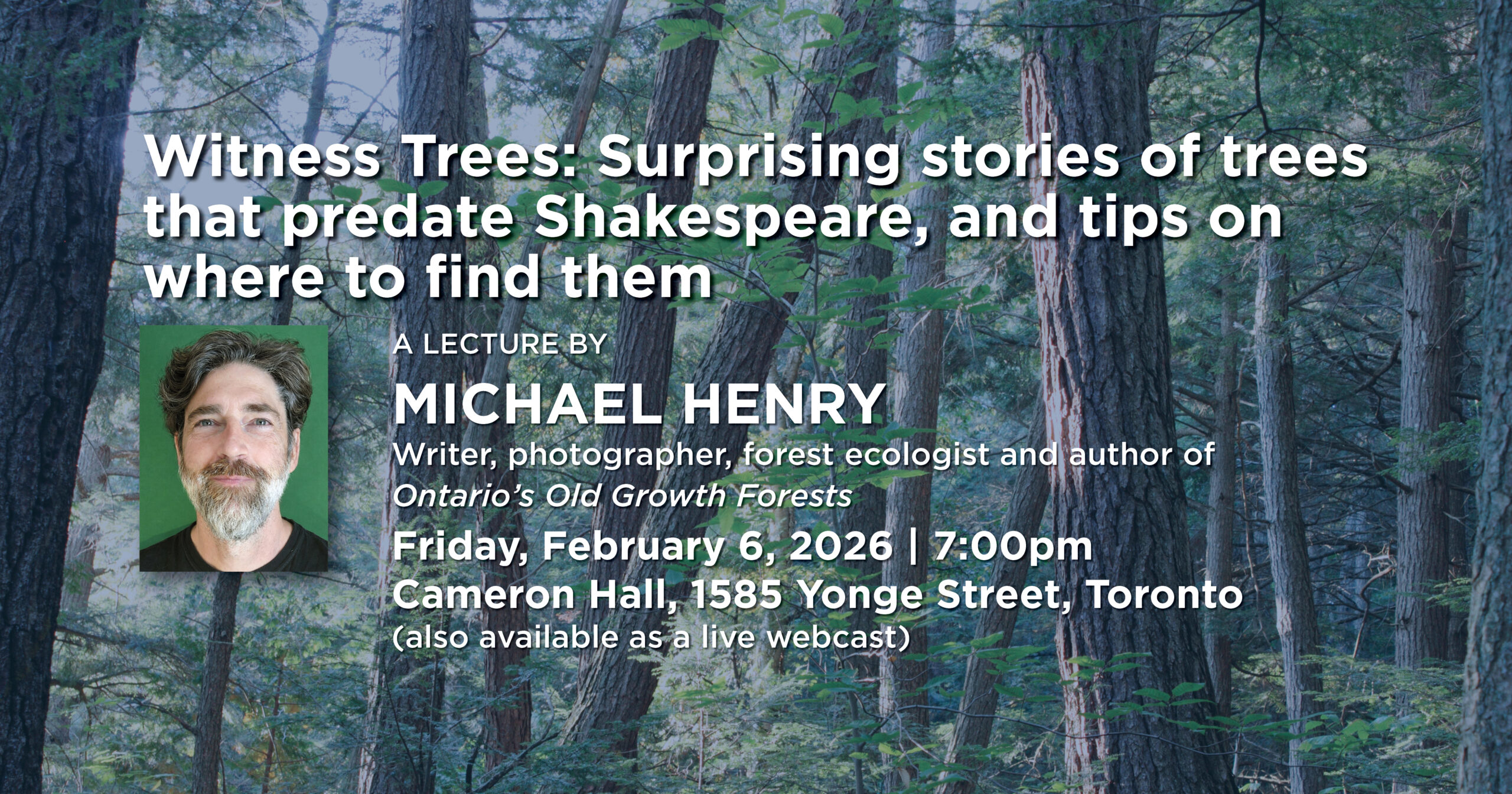
• Witness Trees: Surprising stories of trees that predate Shakespeare, and tips on where to find them

    Cameron Hall 1585 Yonge Street, Toronto

    Some of Ontario’s old trees survive because of their connection to history; maybe they were present during the battle of Queenston Heights in 1812, or grew along the Toronto Carrying Place Trail. Other trees were overlooked because they grow on cliffs or in swamps. A few were preserved as intentional choices by landowners. All have stories woven around them, and written into their trunks, branches, and bark to be read by those who know how. Michael Henry will guide you to Ontario’s oldest and most remarkable trees with colourful photos and stories. You may find yourself more hopeful and inspired than you started out, which is the natural outcome of time spent with old trees – and you’ll likely never see trees quite the same way again.

    BIOGRAPHY

    Michael Henry is the author Old-growth forest walks: 26 hikes in Ontario’s Greenbelt, and Ontario’s old-growth forests. He maintains the list of Ontario’s oldest trees and has found a few himself. He works with volunteers and NGOs like the Wilderness Committee to protect old-growth forests, including the remaining old growth and large roadless areas in Algonquin Park. He is also involved in natural building, and his next book will bring together his broad interests in sustainability and climate solutions. He is currently living with his wife and two kids in Peterborough, Ontario, where he grows native plants in his yard and works to reduce the impact of invasive species on his local forests.
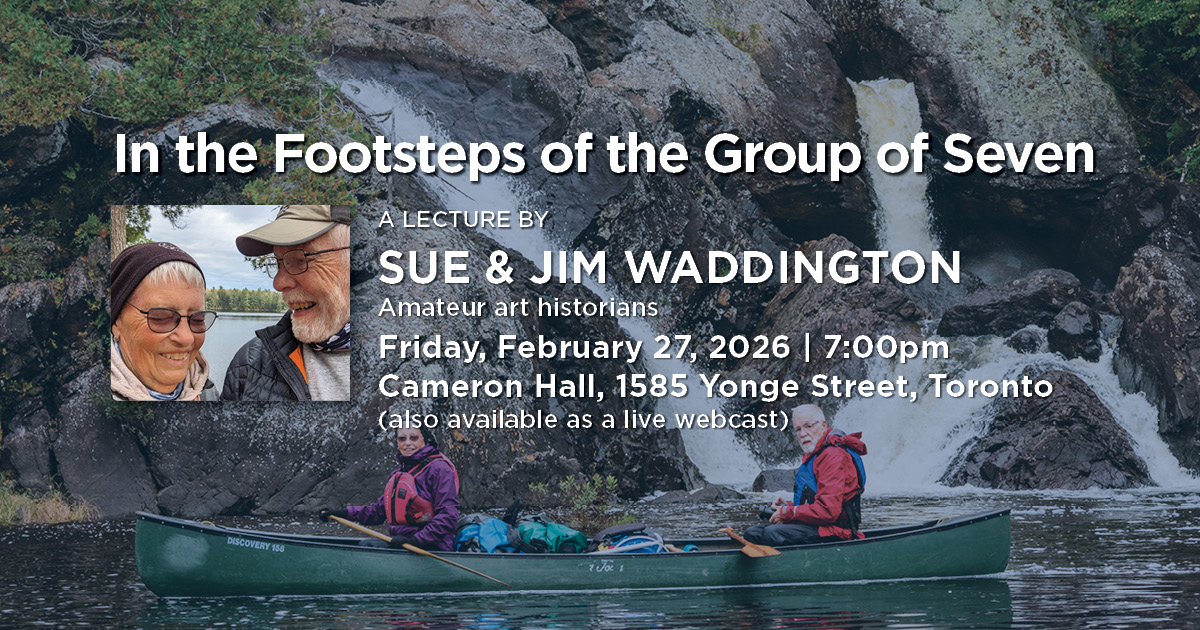
  • In the Footsteps of the Group of Seven

    For almost five decades, Sue and Jim Waddington have searched for places that inspired the Group of Seven painters and Tom Thomson. They especially enjoy locating sites that can only be reached by canoe and foot. Their lecture will compare photographs of some of the 800 painting sites they have found with the corresponding artwork. They will discuss how they find the painting sites and what they have learned about the painters and their art. Since the artists did not keep detailed records of where they worked, each picture represents a puzzle to be solved. For each of the about 800 places located, Sue and Jim photographed the scene and compared it with the artists’ impression. In their talk, Sue and Jim will show their photographs alongside art from Killarney, Algonquin, Neys, Lake Superior and Bon Echo Provincial Parks, the Georgian Bay Islands, Nova Scotia, BC, the Yukon and Nunavut.

    BIOGRAPHY

    Sue Waddington is a retired nurse. She is also an artist – a traditional rug hooker. Her rug hooking designs have won awards in the Burlington Art Centre and the Ontario Hooking Craft Guild. In 1977, she made a rug hooking adapted from A.Y. Jackson’s painting “Hills, Killarney, Ontario (Nellie Lake)” and later that year Sue and Jim paddled to Nellie Lake where they were surprised that they could locate the exact spot where Jackson had sat when he did the painting. After this initial success, they continued searching for other painting locations. Jim Waddington is a retired physics professor from McMaster University who likes maps and the sport of orienteering. He was awarded the McMaster University President’s Award for Excellence in Teaching. Unlike Sue, he has no artistic talent at a